

I ran GigSky's Norway eSIM for eight days on a P&O Norwegian Fjords sailing out of Southampton, from July 25 to August 1, 2026. Three speed tests ashore, one plan run to the end of the trip, and one finding that I did not expect when I bought it.
Verdict: 4 out of 5. Download speeds on Norwegian soil were excellent and coverage reached further inland than I assumed it would. Upload sat at a hard ceiling of around 21 Mbps no matter where I tested, and round-trip latency ran above 300 ms at every location. If you are cruising rather than flying, the Norway country plan is also the wrong product, and I explain why below.
What I bought and what it cost
The plan was GigSky's Norway 10 GB, valid 30 days. Purchased July 20, 2026 at 10:08 UTC through the GigSky website, five days before sailing.
Item | Amount |
|---|---|
Plan price | £13.49 |
Discount (JULY10) | −£1.35 |
Paid | £12.14 |
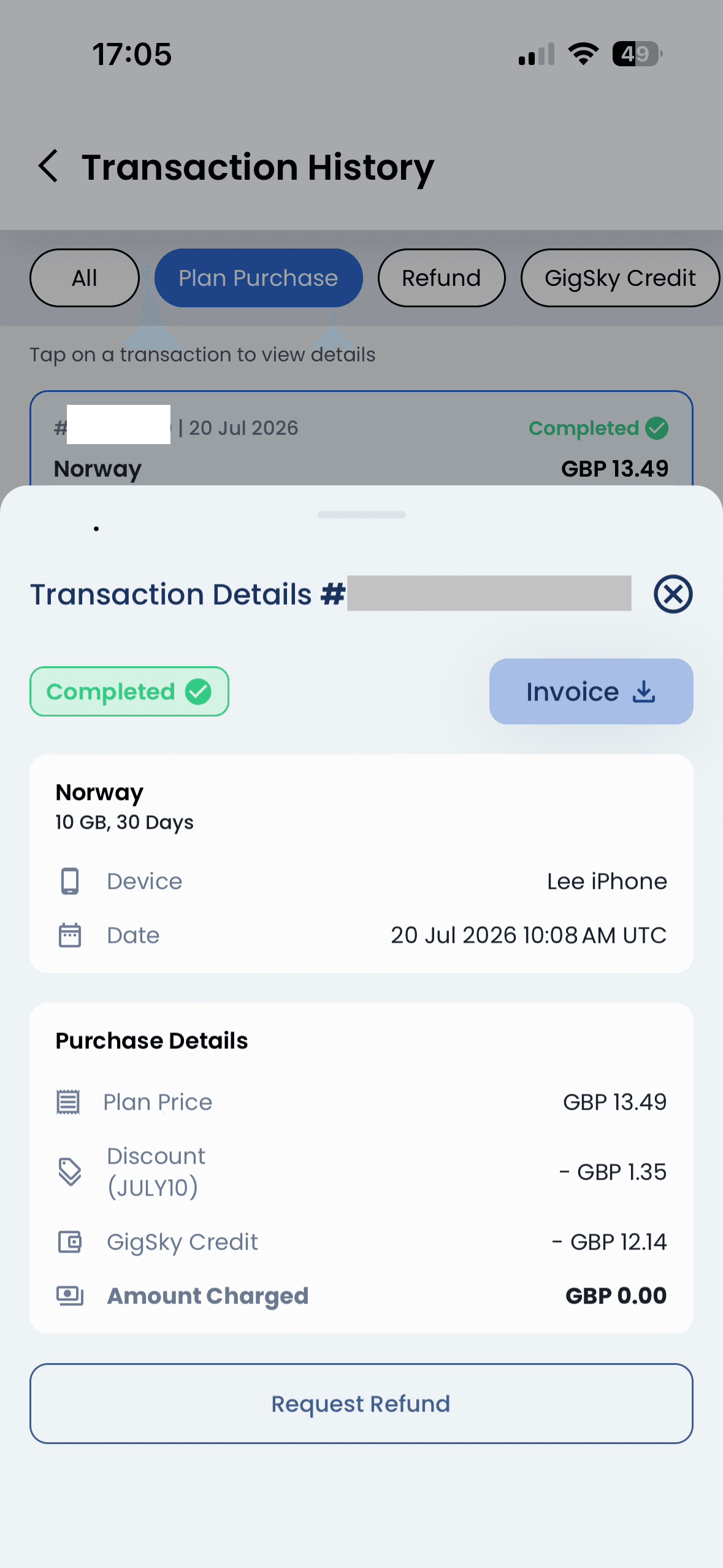
That works out at £1.35 per GB at list price and £1.21 per GB after the code I used. Our own GigSky eSIM discount code, ATESIM, takes 15% rather than 10%, which would have brought the same plan to £11.47, or £1.15 per GB.
Setup and activation on a ship
Test device was an iPhone 15 Pro running iOS 26.5.2. I bought on the website, installed the GigSky app, and signed into the same account. The profile downloaded over Wi-Fi at home without a QR code.
I installed the eSIM on day one leaving Southampton, then it sat dormant. Nothing connected until the ship came within reach of Norwegian coverage. GigSky's terms state that a plan activates automatically once the eSIM connects to an eligible network, so the 30-day validity clock started at first connection rather than at install. That is worth knowing if you are the sort of person who wants everything set up before you leave. Installing early costs you nothing.
Once connected, data worked immediately with no manual APN configuration.
One quirk throughout: the status bar showed "GigSky" rather than a Norwegian carrier name, so there is no way to tell from the phone which network you are actually on. GigSky's Norway page says coverage follows Telenor and Telia. My three Speedtest results all landed on small regional Norwegian operators as servers, which is consistent with that.
Speed test results
All three tests were run outdoors, ashore, standing still, on the GigSky eSIM with my other line disabled.
Location | Time | Network | Download | Upload | Ping (idle) | Jitter |
|---|---|---|---|---|---|---|
Stavanger harbor | 10:20, Jul 27 | 5G, full bars | 330 Mbps | 16.7 Mbps | 323 ms | 4 ms |
Oldevatnet, Olden | 09:33, Jul 28 | 5G, full bars | 122 Mbps | 20.7 Mbps | 306 ms | 126 ms |
Loen Skylift summit | 13:53, Jul 28 | LTE, full bars | 57.2 Mbps | 20.8 Mbps | 354 ms | 160 ms |
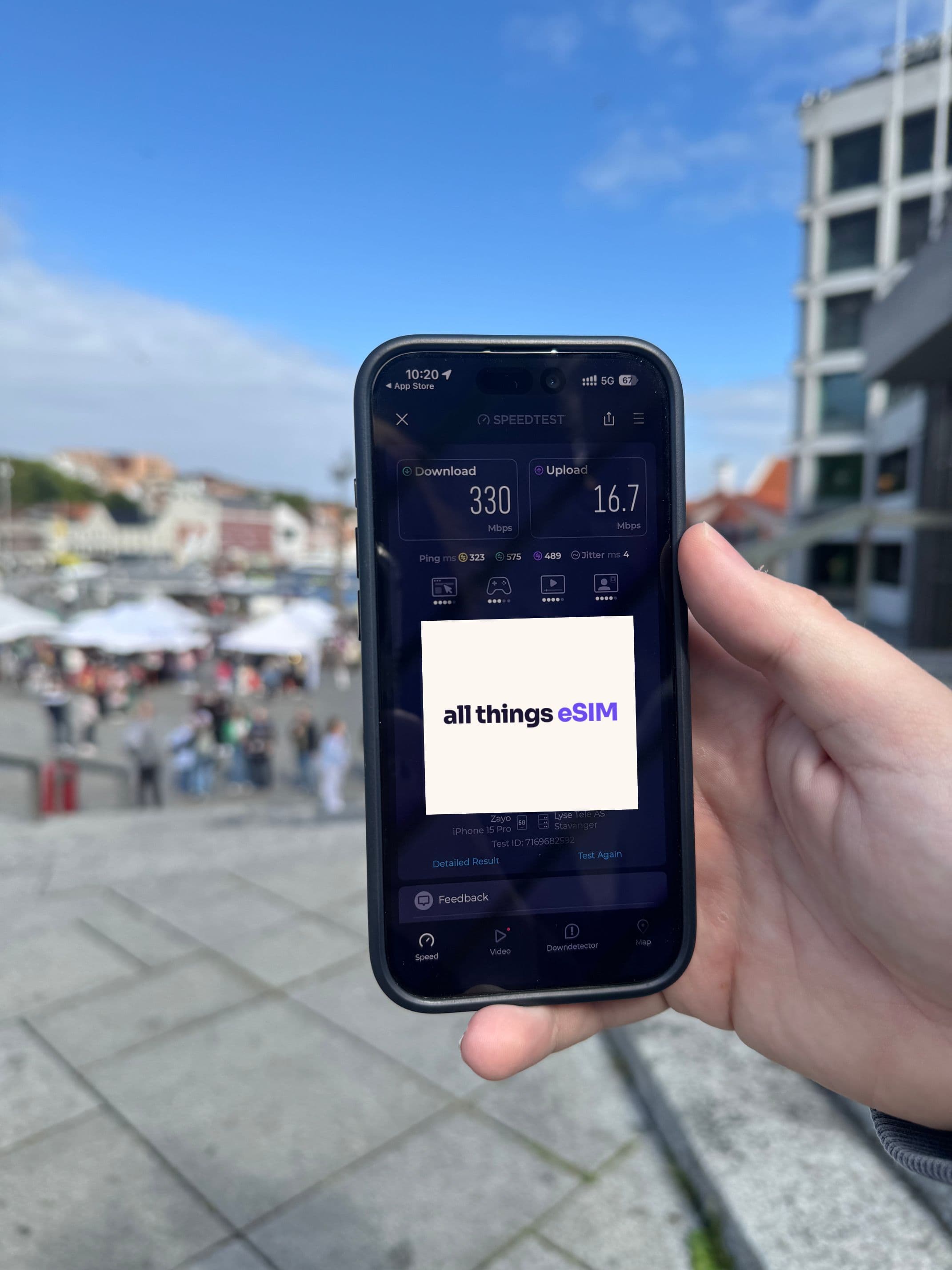
Stavanger harbour. 330 Mbps down in the middle of a working port on a Monday morning, with the market stalls out and a ship's worth of passengers ashore doing the same thing I was. Loaded ping ran to 575 ms down and 489 ms up. Server was Lyse Tele AS in Stavanger, test ID 7169682592.
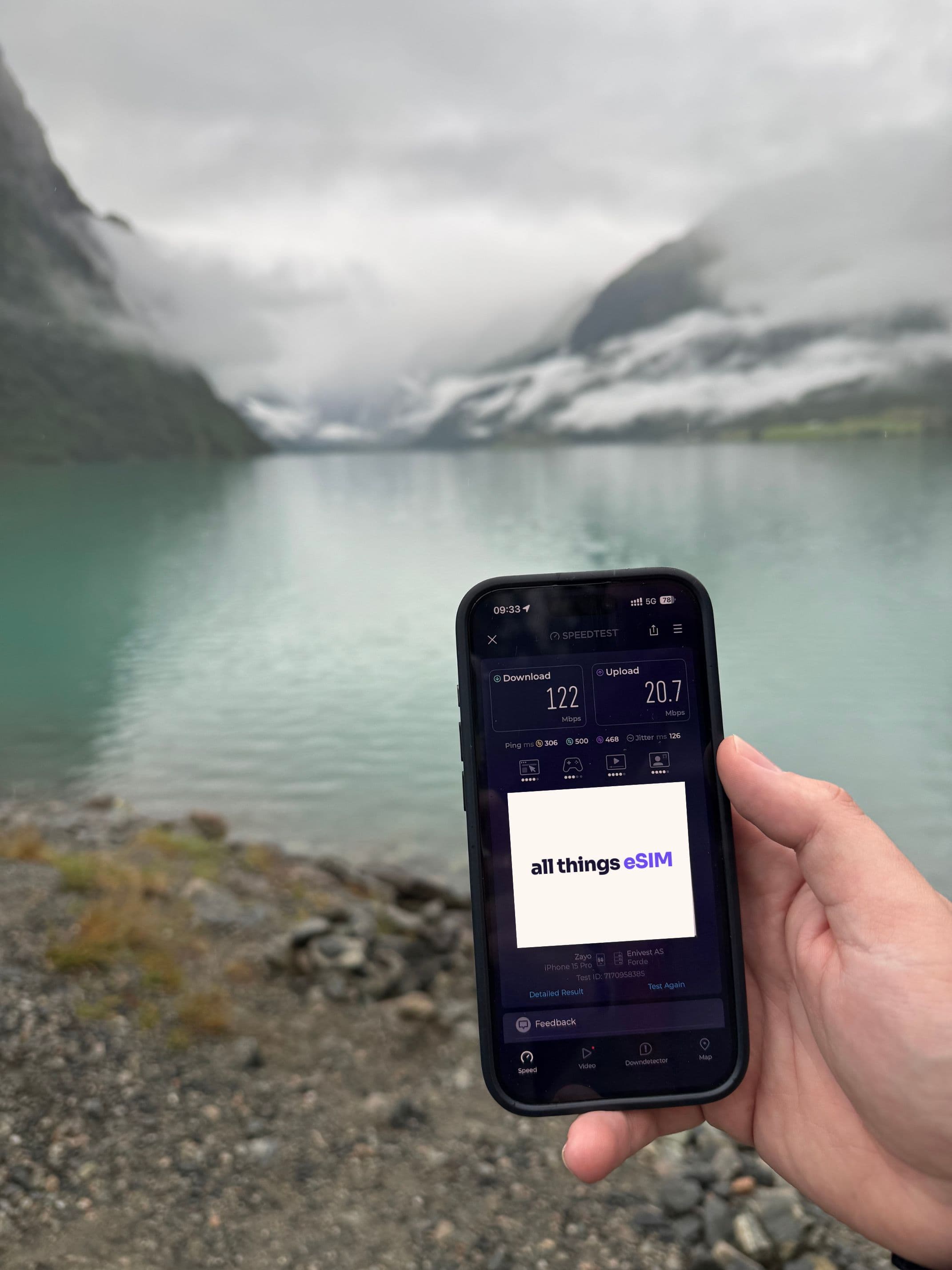
Oldevatnet. A glacial lake roughly 20 km inland from the Olden quay, under low cloud, with mountains on both sides. Full-bar 5G at 122 Mbps. This is the result that surprised me most, because it is not the sort of place I expected a foreign eSIM to hold a strong signal. Server was Enivest AS in Førde, test ID 7170958385.
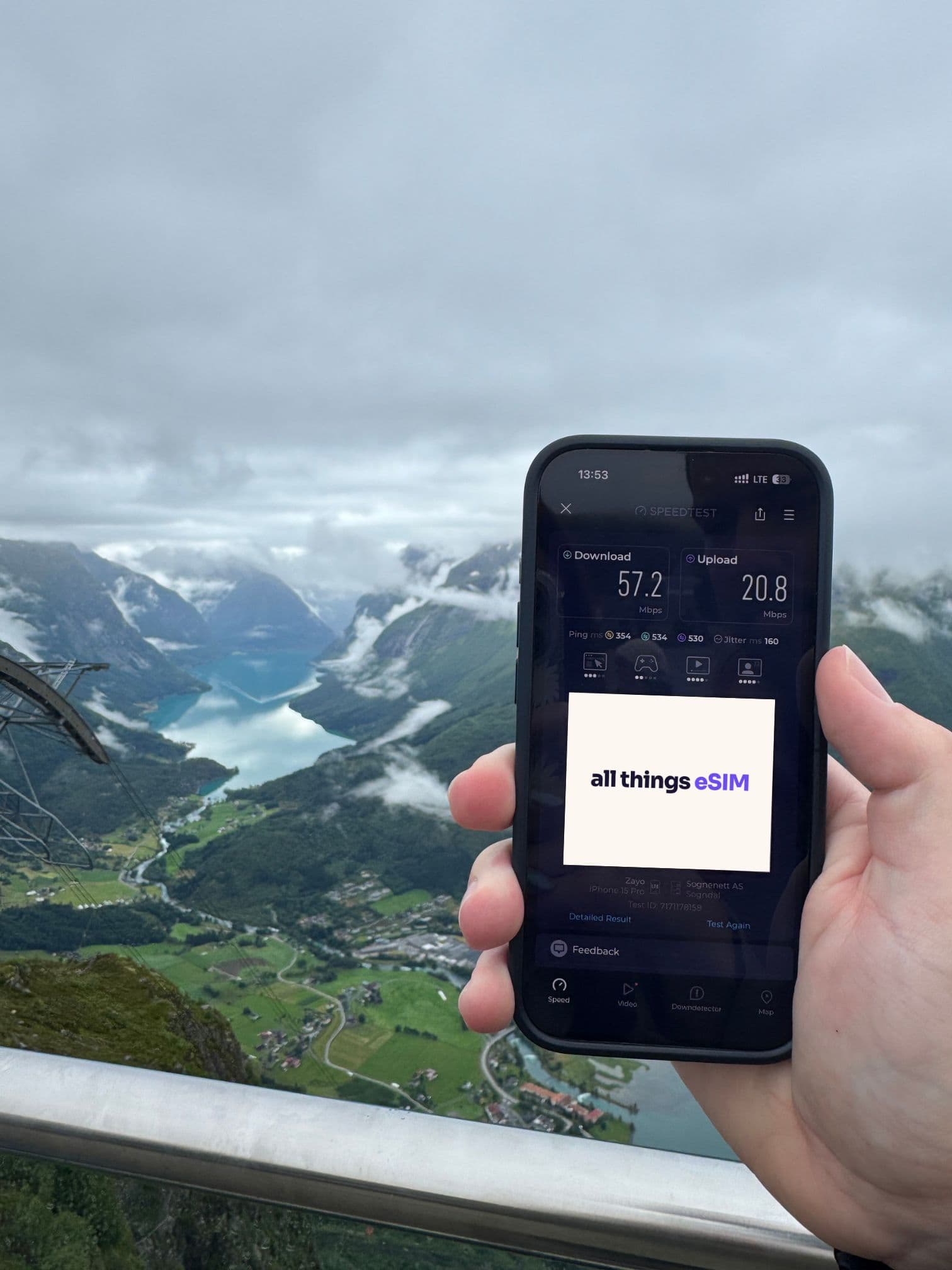
Loen Skylift summit. 1,011 meters up Mount Hoven, reached by cable car from Loen. The phone dropped to LTE here rather than 5G but still held full bars and returned 57.2 Mbps. Server was Sognenett AS in Sogndal, test ID 7171178158.
I did not run a test at Haugesund. Flåm was cancelled when weather stopped us docking, so there is no Flåm figure either.
The upload ceiling
Download speeds across the three tests ranged from 57.2 to 330 Mbps, a spread of nearly six times. Upload across the same three tests was 16.7, 20.7 and 20.8 Mbps.
Downloads varied enormously with location. Upload barely moved. That pattern points to a cap somewhere in the plan rather than a limitation of the Norwegian network, because if local radio conditions were the constraint, upload would have fallen away at the summit alongside download. It did not.
For a cruise passenger this is the number that matters more than the headline figure. Port calls are short. What you are doing in that window is pushing photos and video off the phone, not pulling files down. Around 21 Mbps is enough to send a batch of stills quickly and workable for video, but you are not getting the performance the download figure implies.
Latency and jitter
Idle ping was 323 ms in Stavanger, 306 ms at Oldevatnet and 354 ms at the Loen summit. Under load it ran between 468 and 575 ms.
For comparison, a local Norwegian SIM to a Norwegian test server typically returns somewhere in the region of 20 to 40 ms. These figures are roughly ten times that, and they held across three different test servers in three different parts of the country.
I want to be careful here. The consistency across locations suggests something structural in how the traffic is routed rather than local conditions, and Speedtest identified the connection's ISP as Zayo, a global backbone carrier rather than a Norwegian one, on all three tests. I could not find anything published by GigSky about its Norway routing, so I am reporting what I measured and leaving the cause as unconfirmed rather than guessing at it.
What it means in practice is easier to state. High latency does not slow a download, which is why the benchmark numbers look so good. It shows up as web pages feeling sluggish to start loading, and as noticeable delay on voice and video calls.
Jitter is the related problem and it moved a lot. Stavanger returned 4 ms, which is clean. Oldevatnet returned 126 ms and the summit 160 ms. Jitter is what makes a call break up rather than simply lag. So a WhatsApp video call from the harbor would have been delayed but steady, and the same call from the mountain would have been delayed and unreliable. Messaging, maps and browsing were fine everywhere.
The sea days, and the plan I should have bought
The Norway plan covers Norway. It does not cover a ship at sea, and on an eight-day round trip from Southampton that is a significant portion of the itinerary. My schedule ran Southampton, a sea day, Stavanger, Olden, the fjord cruising day, Haugesund, another sea day, then home. Four days put me within reach of Norwegian coverage. The rest of the time the eSIM had nothing to connect to.
GigSky does sell a product for this. Its Cruise + Europe plan covers over 200 cruise ships as well as 44 countries, and connects to the ship's maritime network at sea and to land networks in port without changing profiles. I did not buy it, and that may be a mistake as I thought I'd rely on the ships Wi-Fi and save some money this way.
For the sea days I used the ship's Wi-Fi, which on this P&O sailing runs on Starlink and came bundled with my drinks package. I did not speed test it. My impression was that it was patchy at times with constant buffering and slow browsing.
If you are cruising Norway rather than flying in, it might be better to buy the cruise plan. The country plan makes sense only if you are content to be offline between ports, or you're happy to use the Wi-Fi should you have it.
How much data a fjords cruise actually uses
I finished the trip with 7.97 GB left of the 10 GB allowance. Total consumption across the whole sailing was 2.03 GB.

That covered maps, messaging, browsing, social, and uploading photos across three port days plus the fjord cruising day. I was not rationing.
Averaged across the four days I had coverage, that is roughly 500 MB a day. On the money I actually spent, £12.14 for 2.03 GB consumed, which technically means I paid £5.98 per GB used rather than the £1.21 per GB, of course that is my own fault for my usage.
The lesson is not that GigSky is expensive. It is that a 10 GB plan is far more than a fjords cruise needs. A 3 GB plan would have covered this trip with room to spare, and if you are on the same kind of itinerary you should size down and spend the difference on the cruise-inclusive product instead.
What it does not do
The Norway plan is data-only. There is no phone number and no SMS, so calls and texts have to go through WhatsApp, FaceTime or similar. If you need to receive a text from your bank, keep your home line active for it.
Hotspot worked without issue, which is not universal among eSIM providers and is useful if you are sharing with a partner rather than buying two plans, or if you want to use your laptop or iPad too.
There is no way to see which underlying network you are on, as covered above.
Who should buy it
Buy the Norway plan if you are flying into Oslo or Bergen for a land trip, you want strong download speeds including well outside the cities, and you are comfortable with a data-only setup. Size it to what you will actually use.
Buy Cruise + Europe instead if you are sailing and want to be fully covered. The country plan leaves you dependent on ship Wi-Fi for a third of an itinerary like mine which can be fine, depending on what you want.
Skip it if your home network already includes European roaming at no extra cost. Norway sits in most UK operators' Europe zone now, and if roaming is bundled into your contract you are paying twice for something you already have. Check before you buy.
How I tested
Eight nights aboard a P&O Norwegian Fjords sailing, Southampton round trip, July 25 to August 1, 2026. Ports visited were Stavanger, Olden and Haugesund, with scenic cruising through Innvikfjorden, Nordfjord, Aurlandsfjord and Sognefjord. Flåm was cancelled due to weather.
Speed tests were run on Ookla Speedtest on an iPhone 15 Pro (iOS 26.5.2), outdoors, stationary, ashore, with the GigSky eSIM as the only active data line. Test IDs are listed against each result above so the raw results can be checked. The plan was bought at retail.